Join the cohort

Presented by Alex Olshonsky & Aurora

Break Your Addiction to Overthinking

A four-week live course to get out of your head and fully into your life.

Join the founding cohortSeptember 8, 2026
Why I made this courseWhat I hope becomes possible for you · 3 min

You can lose a lot of your life inside your head.

The trouble is that overthinking now passes for being a responsible, informed, together adult.

A decision that should take two minutes can consume an afternoon.

One text from a coworker or lover can derail your sleep.

You think about your work instead of doing your best work, or disappear into an imaginary scenario while someone you love is sitting right in front of you.

Eventually, the habit becomes so familiar that it feels like who you are.

Overthinking is a pattern you can recover from.

Most of us were simply never taught how to work with it in a practical way.

With practice, you can catch the loop while it is happening, soften the body, and return to what matters most to you.

Over time, you stop being pushed around by every thought that enters your mind.

More of your attention becomes available for the work you care about, the people you love, and the moments of creativity, ease, and flow that make life feel radically alive.

Kishan Patel
Even after years of meditation and inner work, I still couldn’t get out of my head. Alex’s workshops changed my relationship to thought and gave me simple practices I use every day. They’ve brought more ease, peace, and flow into my life than anything else I’ve tried.
Kishan PatelEntrepreneur

This course may be for you if…

  • You spend more time than you want ruminating about work, dating, relationships, or yourself—often circling the same thoughts.
  • You may have tried therapy, journaling, Headspace, Calm, Waking Up, or even practiced for years. Some of it has helped, but the overthinking still returns.
  • You understand your patterns—sometimes in great detail—but trying to think your way out of overthinking only takes you so far.
  • Overthinking gives you a brief feeling of control or relief, but rarely leaves you any closer to an answer.
  • You’ve tasted deep presence—in meditation, nature, movement, conversation, or creative work—and want more access to it in ordinary life.
  • You’re ready to work on this for a month and see what changes when you practice daily, reduce your digital inputs, and try some new ways of working with your mind and body.

The course’s distinctive approach

The course draws on the three bodies of work that most changed my own relationship with thought.

01

Addiction recovery

See the problem clearly, count the cost, take ownership, and begin choosing differently.

02

Somatic psychology

Harness the intelligence of the body so the mind no longer has to keep hypervigilant watch.

03

Contemplative practice

Use meditation and attentional training to unhook from thought and open to a wider view.

What’s included

An experiential, practice-heavy container with enough support to make the work embodied and integrated into your life.

Live

Two sessions each week

One 90-minute teaching session and one 60-minute practice lab session.

Learn

Four focused modules

A concise online curriculum with guided audio, video, and preparation for the live sessions.

Practice

A daily practice

About 20 minutes of self-practice each day, plus small experiments to integrate this into your life.

Together

Community and accountability

A private online community space for practice, sharing, and accountability.

Personal

Support with Alex

A 1:1 session with Alex, with timing and format shaped to the cohort.

Expanded

Guest teachers and perspectives

Selected sessions with complementary voices in movement, psychology, and lived experience.

Begins
September 8, 2026
Length
Four weeks
Live practice
One 90-minute session + one 60-minute session weekly
Investment
$749
Join the founding cohort

This course has one singular aim.

You will discover that you can catch yourself mid-spiral and let it release back into the moment in front of you.

Each catch compounds until the grip of overthinking begins to loosen on its own—and conversation, work, creativity, and life become easier to rejoin.

One meta-move you can bring into your life.

Learn to catch the moment thought takes over, soften the body beneath it, and return to what matters.

How the practice developsCatch the loopSoften & releaseReturn & trust
At firstOverthinking runs on autopilot

You notice overthinking only after you’ve been lost in it for a while.

Your body stays tense, and the thought feels urgent and hard to put down.

Returning to life takes effort because the thought still feels like it needs solving.

With practiceYou can work with it in real time

You catch overthinking while it is happening, before the loop completely takes over.

You soften the body, and the thought loosens without needing to solve it.

You return sooner to what matters most, trusting that you don’t need to follow the thought.

Integrated/wu weiWhen the practice becomes natural

Overthinking still happens, but you notice it early and it no longer becomes a problem.

The body softens, and the thought releases naturally with little or no effort.

You return naturally to life and flow, trusting thoughts to come and go on their own.

What we’ll work on over four weeks

The curriculum builds a ladder of resources. The body and openness are complementary doors; different doors work for different people and moments.

01

Catch the loop

Attentional awareness and interruption

Recognize rumination earlier, relax its momentum, and create enough space to return to what matters.

02

Come back to the body

Somatic grounding

Learn to collaborate with the body as a grounded resource when thought feels charged or braced.

03

Open beyond thought

Attentional flexibility

Widen attention through the senses, space, and movement, and learn which doorway fits the moment.

04

Live the practice

Integration and continuation

Consolidate the daily practice, strengthen return and trust, and leave with a plan to bring this into your life.

Structure and accountability for attention in the modern age.

Four weeks of daily practice, fewer inputs, and heartfelt people beside you.

01

A practice you can carry on your own

A daily sit, brief morning and evening touchpoints, and catches in real life help returning become a new habit.

02

People who help you keep going

A private community and practice sessions give you somewhere to share wins and challenges and stay accountable.

03

A four-week screen reset

We reduce the inputs that keep the nervous system activated—fewer compulsive inputs, less automatic distraction, and more room for life.

When thought loosens, life comes forward.

What people have said after attending our workshops.

It felt like, for a long time, I had forgotten this part of me—and now it was taking the scene again. My thoughts had already lost their grip on my consciousness. They became secondary. They were still with me, but with a very loose grip.
Workshop participant
Once I let go of that judgment, something just bubbled up by itself. It was so nice to feel real attention, warmth, and presence.
Workshop participant
My brain wasn’t turned off—it was very instinct-based, with the activity rather than thinking about it or trying to control it. It felt more like a dance between thinking and moving.
Workshop participant

Who this course may not be right for

  • You are seeking treatment for diagnosed OCD rumination or another acute mental-health concern. A licensed clinician is the right primary support.
  • You have no interest in contemplative, body-based, or experiential approaches.
  • You are unwilling to practice on your own, try suggested changes such as reducing screen inputs, or participate meaningfully in the live and online container.
  • You want intellectual information and frameworks alone. The course asks you to try unfamiliar practices and work with what happens in real-time.
  • You are an advanced meditator looking to work only with subtle thoughts.
  • You don’t like mildly funny dudes with long, thinning hair.
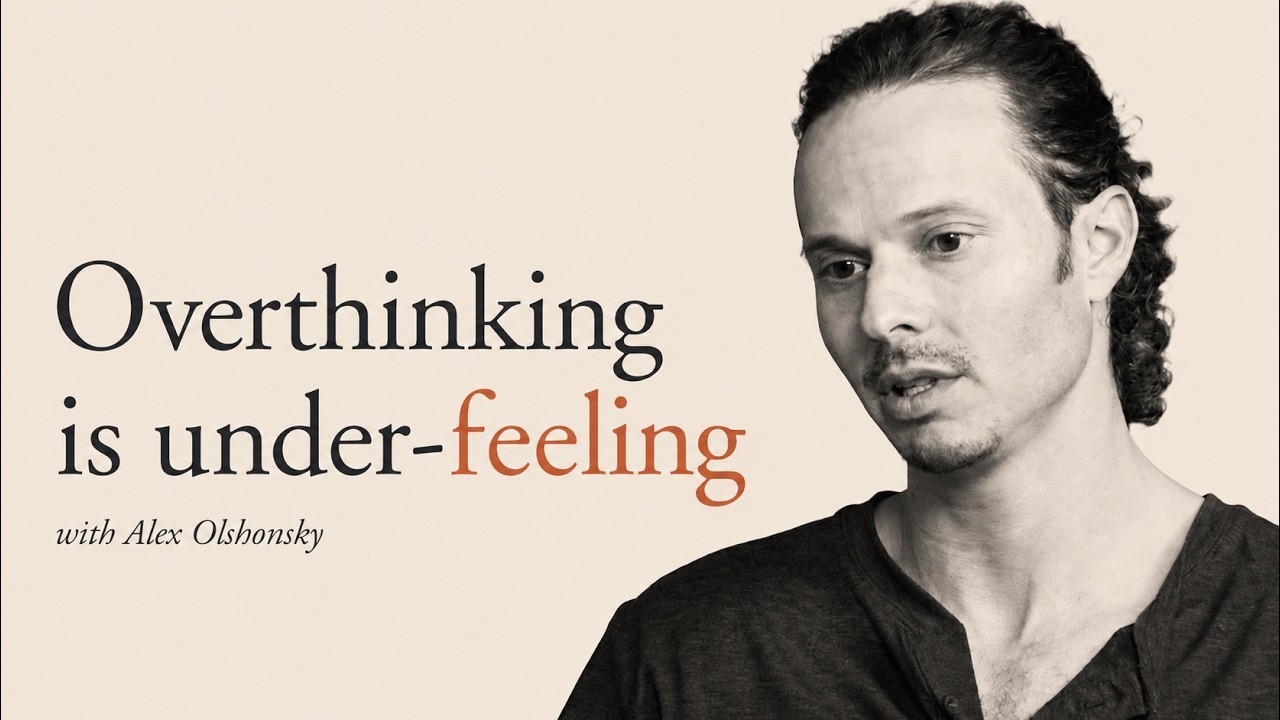
Alex Olshonsky

Meet your guide

Hi, I’m Alex.This course is the culmination of my life’s work, and my central thesis.

My path here began with a multi-substance addiction that nearly took my life. Recovery sent me headfirst into every modality I could find, then deeper, into somatic psychology and years of intensive contemplative training across numerous traditions.

And what I found is that addiction gets subtler the further you follow it. Once the substances were gone, I had to unhook from the screens, modernity’s drug of choice. Even once I was free of that, as my spiritual practice matured, I realized the final boss was the compulsion to think my way out of uncertainty, discomfort, and life itself.

Relaxing that compulsion has led to the deepest freedom of my life, and helping people do the same is now my mission. It’s taken different forms over the years, whether co-founding Natura Care, a nonprofit for spiritual care in addiction recovery, holding somatic sessions as a Certified Hakomi Practitioner, leading men’s groups and retreats, or coaching executives. These days it centers on teaching and writing about freedom from overthinking, and my essays on the subject have reached hundreds of thousands of readers.

I want to be clear that none of these traditions or practices began with me. I see my work as a bridge, distilling the best of what I’ve found and bringing it to you, for modern life.

I still overthink, by the way. It just releases on its own now and isn’t much of a problem, because something wiser than the voice in my head is running the show. My hope for you with this course is simple: to stop thinking your way through the one life you get and taste just how good it can be to flow with it.


Four weeks live · Founding cohort

Build a freer relationship with thought.

Begins Tuesday, September 8, 2026.

$749
Join the founding cohort

You’ll receive access to

  • One 90-minute teaching session and one 60-minute practice lab each week
  • The complete four-module curriculum
  • Guided daily practice
  • Your practice pod and private community
  • A 1:1 session with Alex, with timing and format shaped to the cohort
  • Selected guest teachers and perspectives

Frequently asked questions

Everything you need to know about the live schedule, practice, support, and cost. Still have questions? Get in touch with Alex.

01When do the live sessions take place?

Live sessions are Tuesdays and Thursdays at 10:00 a.m. Pacific. Tuesdays are the main teaching and practice session; Thursdays are a practice lab, where we train the skills together in real-time.

02What if the live times do not work for me?

This course is built for busy people with full lives. The teaching and main-room practice are recorded, so you can follow asynchronously and stay fully on track. That said, I encourage you to come live whenever you can — the relational work, live practice, and guest speakers are where the course goes deepest, and the small-group breakouts are unrecorded by design. Between sessions, the private community is another place to ask questions, share wins, and stay connected.

03How much time should I expect each week?

Plan on the two live sessions each week, plus about 20 minutes of daily practice, which we'll help you build over the month.

04How much of the course is teaching versus practice?

You can't think your way out of overthinking, so the course’s live sessions are deliberately practice-heavy. Brief, focused material will provide guidance and a frame, but most of our time together is spent practicing, applying, troubleshooting, and exploring presence.

05Are payment plans or scholarships available?

Yes to both. If splitting the $749 into two payments would help, email us and we'll set it up. The same goes for scholarships: a small number of reduced-rate spots are set aside for people for whom cost is a prohibitive barrier, in exchange for detailed feedback as part of the founding cohort.

06What is the refund policy?

Sometimes you need to experience the course before you can know whether it is right for you. If it does not feel like the right fit during the first week, email us and we will refund your full payment.

07What does “founding cohort” mean?

It means you’re in the first full run of the course. The material has been tested across workshops this past year, but this is the first time it's running as a complete four-week cohort. I'll ask for your candid feedback as we go, and future cohorts will be better and more expensive because of it.

08Do I need meditation or spiritual experience?

No prior experience is required. Readiness and curiosity matter more. The course welcomes first-time practitioners and experienced practitioners who still get caught in this pattern.

09Why call overthinking an addiction?

Because it works like one. Something uncomfortable arises, and the mind reaches for a thought the same way people reach for an app or a drink. It's a practical lens rather than a clinical diagnosis, meant to be immediately useful in your life. And the frame carries a hopeful promise: people recover.

10Is this therapy?

No. The course is educational and practice-based, and it isn't a replacement for psychotherapy, medical care, or clinical treatment. Plenty of people take this alongside therapy, and the two complement each other well. But if you're navigating something acute, like clinical OCD, severe anxiety, or unprocessed trauma, please work with a specialized clinician or practitioner first.

Come back to the life in front of you.

A freer relationship with thought begins one catch at a time.

Join the founding cohort